
For Parents / Carers
BrainWaves is a registered charity on a mission to improve the support that your children get for their mental health and wellbeing.
Your child can take part through their schools or colleges, either via education, research, or a combination of the two.
What does BrainWaves offer your children?
Backed by the University of Oxford and grounded in science, BrainWaves offers free wellbeing lessons and training for teachers designed to help your child’s school or college understand and support their students’ needs.
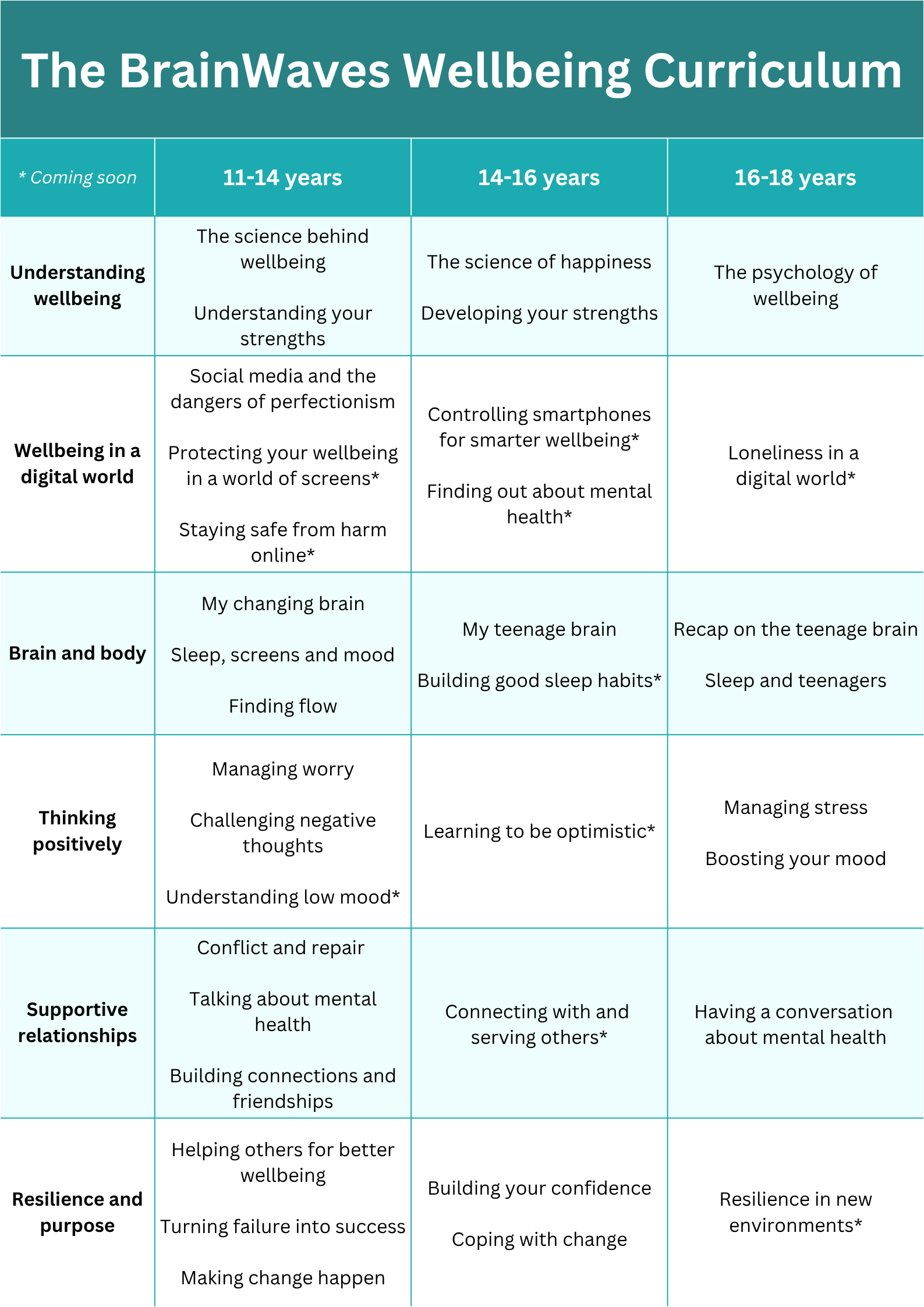
The curriculum we have developed supports students in understanding what promotes good mental health, alongside building the skills and habits that sustain it over time. What makes us different is our focus on ‘Positive Psychology’, emphasising the development of positive, preventative strategies that help young people strengthen their wellbeing and thrive.
Click here to see an overview of the lessons we have developed. You can find out more about our lessons on our education website, education.brainwaveshub.org.
We also offer schools, colleges and students opportunities to get involved with research studies. Our studies are all designed to improve outcomes for the mental health and wellbeing of young people. Our largest study, the Cohort Study, gives your child a voice and platform to share their lived experiences with researchers, educators and academics worldwide.
You can find more information below.

My child attends a BrainWaves Research Partner school or college - what does this mean?
BrainWaves Research Partners are schools and colleges who are actively prioritising their students’ mental health and wellbeing by partnering with BrainWaves. Their staff has exclusive access to training, support, and networking through BrainWaves.
If your child attends a BrainWaves Research Partner school or college, they will likely have participated in BrainWaves wellbeing lessons and been given the opportunity to take part in our studies through wellbeing research, interventions, and student feedback.
What research opportunities might my child be invited to take part in?
Our main research study is the annual Cohort Study. Your child will also be invited to take part in other studies developed by BrainWaves through their school or college.
All opportunities will be entirely optional. As such, we will make sure your child knows enough about the study and, where applicable, how their data is used, so that they can make an informed decision about whether or not they wish to take part.
We also request that your child’s school or college inform you about any studies they are invited to take part in and, where appropriate, seek your permission.
What impact has BrainWaves research had so far?
Over the past three years, BrainWaves has helped students access better mental health education through:
- Supporting 55 schools and colleges in understanding their students’ needs through Cohort Study reports, like this one;
- Inviting staff at schools and colleges to develop their understanding of adolescent wellbeing through training events;
- Holding a mental health and wellbeing conference to share students’ voices in our research with researchers, educators and government officials;
- Developing wellbeing lessons, available for free, to all schools and colleges. As of June 2026, these have been accessed by more than 2500 schools worldwide.
You can find out more about the impact of BrainWaves research by visiting: Impact Report 2026.
How do I contact BrainWaves?
Visit our Contact Us page to find our contact details.
Cohort Study FAQs for parents / carers
Please find below some of the most frequently asked questions from parents / carers about our Cohort Study. If your child is under the age of 18, a parents’ Cohort Study information pack and video containing further information is available from your child’s school or college.
My child has been invited to take part in your Cohort Study. What is this?
Our main study, the Cohort Study, is an annual mental health and wellbeing questionnaire. In previous years, this has only been available for ages 16+, but from 2026 we are rolling out our offer to younger secondary school ages (11+).
Their answers will be de-identified (made anonymous) and uploaded to a secure research platform. This data will have a range of uses. For example, it may be used to inform researchers worldwide, to develop educational resources and teacher training, and to advise at a higher level through news articles and national initiatives.
Your child will receive a certificate of participation and have the opportunity to make their voice and lived experience heard, anonymously. This will feed into a report that your child’s school or college receives, allowing them to plan their wellbeing offer based on what their students are saying they need support with.
If your child is under the age of 16, we ask if they would like to take part in addition to seeking ‘opt-out’ parental consent. This means that if your child is under the age of 16, they will be included in the study unless you let the school know you’d prefer them not to take part.
If your child is over the age of 16, they are independently able to decide to take part or not through school or college. A parents’ Cohort Study information pack and video is available from your child’s school or college.
Where can I view the results of the BrainWaves Cohort Study?
Visit our BrainWaves Research Data page to see the latest results from the BrainWaves Cohort Study.
Does my child have to take part?
No. If your child is under the age of 16, we ask if they would like to take part in addition to seeking ‘opt-out’ parental consent. This means that if your child is under the age of 16, they will be included in the study unless you let the school know you’d prefer them not to take part, or if they choose not to themselves. If your child is over the age of 16, they are independently able to decide to take part or not through school or college.
When and where will my child take part?
Your child will be given the option to take part in a timetabled, supervised session in their school or college, unless they are under the age of 16 and their parent has opted-out. If they have left school or college, they will be sent an email from BrainWaves inviting them to take part in their own time.
What happens after my child takes part?
Once your child submits their data, it is de-identified (made anonymous) and sent to a secure, world-class online portal, hosted by Swansea University, called SeRP. Then, it is analysed by experts at Oxford University. Schools and colleges receive a report of their cohort’s answers (NOT individual student answers) which allows them to use real data to inform their policies, practices and curriculum. Researchers can apply for access to this de-identified data to use in their studies.
Who has access to my child’s data?
Researchers who apply through SeRP’s rigorous application process may be granted access to your child’s de-identified (anonymous) data. Select members of the BrainWaves safeguarding team may also have access through SeRP to your child’s name, school and areas of concern. Please note: even in instances of safeguarding alerts, members of BrainWaves’ team can not see your child’s answers, but they can see areas where concerns are raised so that they can follow up appropriately using BrainWaves’ unique safeguarding protocol.
Is this research GDPR compliant?
Yes. Protecting your child’s data is one of our key priorities. We pride ourselves on our ability to keep data secure – it’s why we are working with Swansea University, a world-class leader in data security, via their online data platform, SeRP. Get in touch if you have any questions around our GDPR procedures, or if you would like to see our Data Protection Summary.
Does this research have ethical approval?
Yes. Ethical approval was granted through the ethics application process at Oxford University (Provided by the Central University Research and Ethics Committee (CUREC)). If you wish to know more about our ethical approval, please get in touch.
What questions do you ask?
Your child will be asked about a range of age-appropriate topics, such as relationships, discrimination, social media, lifestyle, mental health, harmful behaviours and general wellbeing. We understand you may have questions about whether the content will be appropriate for your child. Both the KS3 (11 – 14) and KS5 (16+) questionnaires are age-and-language appropriate, in particular around sensitive topics such as self-harm.
In these cases, more detailed questions only appear if a young person indicates they have experience in these areas to minimise the chance of exposure to a topic they are not aware of. This data is vitally important for understanding the lived experiences of young people today.
Each section and each individual question within a section is optional. There will be notifications ahead of sensitive content, and the option for students to bypass. No student will be made to answer any question they opt out of.
Can I see the questions before my child takes part?
Yes. A full list of the questions in the Cohort Study is available via your child’s school/college, or you can request them by contacting BrainWaves.
How do you support children who might be adversely affected by the content of the questionnaire?
Training and resources are provided to schools and colleges on how to support young people taking part in the questionnaire. Additionally, once participants have clicked ‘end questionnaire’, they are signposted to online sources of support and information around mental health and wellbeing.
How do you support young people who indicate that they are at risk of harm?
BrainWaves has developed a unique safeguarding procedure, designed to safeguard the young people who participate while maintaining ethical research integrity.
For students under the age of 16 who answer specific questions in a way that indicates they are at risk of harm or danger, an alert is raised to the BrainWaves Safeguarding Lead. BrainWaves staff will then email your child’s school safeguarding lead by midday if any of their students have triggered this alert, along with the area of the questionnaire – not the answer – that has triggered the alert, for example, ‘Matreatment’, so the school safeguarding lead can follow up appropriately. Please note – BrainWaves are still unable to see the answers of any individual student, due to the anonymous nature of the research.
For students aged 16 +, we have developed a flagging system which allows students to tick a box to say if they would like support with a specific area that they have been negatively affected by. This box will appear in sections where more sensitive questions are asked, and students can tick the box multiple times throughout the questionnaire to trigger support for the different areas. Should a student tick the box to request support from BrainWaves, we will email the student within 5 working days with a range of support options that they can choose from. The support options include an emailed letter for the student to take to their GP to request further assistance from a mental health professional or to be signposted to online sources of support which are individualised and specific to the areas the student asked to discuss further. They can also request a referral to the school or college safeguarding lead, or they can say that they ticked the box by mistake or do not wish to be followed up with further. BrainWaves will attempt to contact each student 3 times.
If you have any questions or would like more information about our safeguarding procedure, please contact us at support@brainwaveshub.org, and we will be happy to help.
Further support and guidance for parents
Mental health support links for your child
If you are looking for advice, guidance or support with your child’s mental health and wellbeing, the following organisations offer trusted information and support. If you are concerned and wish for further advice, please contact a mental health professional.
- Best for you: is a new approach to mental health care designed for young people and their families.
- CALM: We’re the Campaign Against Living Miserably (CALM) and we’re taking a stand against suicide.
- Childline: Free service for children and young people - here whenever they need support or advice.
- Kooth: Age appropriate discussion boards, magazine & help articles.
- Mind Out: mental health service run by and for lesbian, gay, bisexual, trans, and queer (LGBTQ) people.
- NHS: get in contact with your local NHS services for talking therapy services.
- Samaritans: If you need someone to talk to, we listen. We won't judge or tell you what to do. Ring Samaritans on 116 123
- Side by Side: Online peer support community where you can talk about your mental health and connect with others who understand what you're going through.
- Young Mind: provide advice and information to give young people the tools to look after their mental health.
- BEAT (Formerly Eating Disorders Association) UK’s eating disorder charity, missioned to end the pain and suffering caused by eating disorders.
- NSPCC: the leading children’s charity in the UK, specialising in child protection and dedicated to protecting children today to prevent abuse tomorrow. Ring NSPCC Helpline by 0808 800 5000, emailing help@NSPCC.org.uk or completing the report abuse online form.
Parent support services
If you are looking for advice, guidance or support with your child’s mental health and wellbeing, the following organisations offer trusted information and support:
YoungMinds Parents Helpline
Provides free, confidential advice for parents and carers who are concerned about their child or young person’s mental health. The service offers guidance on understanding what a child may be experiencing, how to support them, and where to access further help. Visit YoungMinds Parents Helpline.
Family Lives
Offers advice and support for parents and carers on a wide range of family issues, including children’s emotional wellbeing, relationships and parenting challenges. Visit Family Lives.
NHS: Children and young people’s mental health services
Provides information about mental health support available through the NHS, including when and how to seek help for a child or young person. Visit NHS Children and young people’s mental health services.
Childline
Offers free, confidential support for children and young people under 19, including advice and someone to talk to when they are struggling with their mental health or wellbeing. Visit Childline.
Wellbeing strategies taught in BrainWaves Wellbeing Lessons
Every BrainWaves lesson is built around evidence-based strategies designed to support young people’s wellbeing. These include:
- A break from social media: Exploring how taking time away from social media can support wellbeing, reduce stress and encourage real-world connections.
- Active listening: Understanding how giving someone your full attention can strengthen communication and relationships.
- Deep breathing: Exploring how breathing techniques can help regulate stress and anxiety responses.
- Practising positive emotions: Examining how intentionally noticing and developing positive experiences can support wellbeing.
- The power of exercise: Looking at how physical activity supports both physical and mental health.
- Three good things: Exploring how reflecting on positive experiences can help build wellbeing habits.
- Worry time and the worry tree: Learning evidence-informed approaches for managing worries and problem-solving.